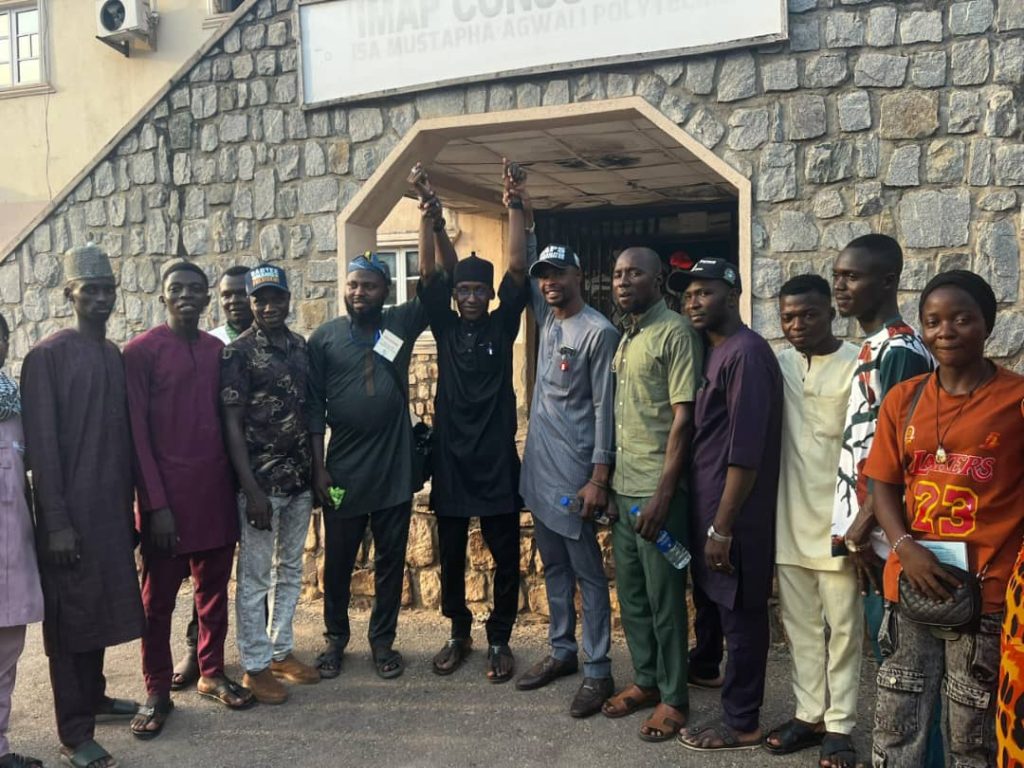
On March 11, 2026, the National Association of Polytechnic Students (NAPS) North Central Nigeria demonstrated its commitment to democratic governance and student representation by officially observing the Students Union Government (SUG) elections at Isa Mustapha Agwai 1st Polytechnic, Lafia, Nasarawa State. The visit was led by the North Central Regional Coordinator, Ahmed Peter Hassan (CNPS), who arrived with a delegation of regional student leaders to witness and evaluate the electoral process at the institution widely regarded as one of the region’s premier polytechnics.
The presence of the NAPS leadership underscored the importance of transparency, credibility, and democratic participation within the polytechnic education sector. Student union elections serve as a critical platform for nurturing responsible leadership, strengthening civic participation among young Nigerians, and ensuring that student voices remain represented in institutional governance. As such, the observation mission by NAPS aimed to reinforce confidence in the electoral process and encourage institutions across the North Central region to maintain similar standards of accountability and fairness.
During the exercise, the election process at Isa Mustapha Agwai 1st Polytechnic (IMAP), Lafia was widely regarded as orderly, transparent, and credible. The electoral process demonstrated a high level of organization, student participation, and institutional cooperation. Observers from the NAPS delegation noted that the conduct of the election reflected best practices in campus democracy, ensuring that students were able to exercise their franchise freely and without undue influence.
Following the successful conclusion of the election, the NAPS North Central Coordinator, Ahmed Peter Hassan, held a courtesy interaction at the office of the Dean of Students Affairs, Shammah S. Kpanja, an academic staff member of the institution and the serving National President of the Academic Staff Union of Polytechnics (ASUP). The meeting provided an opportunity to discuss the significance of student leadership, institutional cooperation, and the role of unions in promoting a stable and productive academic environment across Nigerian polytechnics.
In his remarks, the Coordinator commended the leadership and management of the institution for fostering an enabling environment that allows student democracy to thrive. Special recognition was given to the Rector, Nuruddeen Mua’zu Maifata, whose administration was praised for implementing student-friendly policies that prioritize welfare, academic development, and social stability on campus. According to the NAPS leadership, the support of institutional management is often a decisive factor in ensuring peaceful and credible student elections.
The NAPS delegation also extended warm congratulations to the newly elected Students Union Government President, Ukasha Ibrahim, and other elected officials who emerged victorious at the polls. The leadership of NAPS acknowledged the election as one of the most credible and transparent student union elections witnessed in recent times within the region. The Coordinator emphasized that the emergence of new student leaders represents both an opportunity and a responsibility to promote unity, integrity, and purposeful representation within the institution.
While celebrating the successful election, Ahmed Peter Hassan used the occasion to remind the newly elected leaders of the weight of responsibility placed upon them by the student community. He advised the leadership of the Students Union Government to prioritize discipline, good conduct, and responsible leadership. According to him, student leaders must serve as role models who embody the values of integrity, accountability, and service to the broader student population.
In his address to the student body, the NAPS Coordinator also spoke strongly against social vices that threaten the future of Nigerian students. Issues such as cybercrime, cultism, examination malpractice, drug abuse, and other forms of misconduct were highlighted as practices that undermine both personal development and the reputation of Nigerian higher institutions. He encouraged students to remain focused on academic excellence and character development, noting that the reputation of the polytechnic sector depends largely on the conduct and achievements of its students.
Furthermore, he emphasized that the role of student union leaders should extend beyond advocacy to responsible partnership with institutional authorities. Rather than adopting confrontational approaches to institutional challenges, he encouraged constructive dialogue, active engagement, and consultation with management. According to him, this collaborative approach ensures that student concerns are addressed effectively while maintaining a peaceful and productive academic environment.
The Coordinator reiterated that sustainable progress within tertiary institutions can only be achieved when students and management work in synergy. Through continuous dialogue and mutual respect, institutions can address pressing issues affecting student welfare, infrastructure, and academic development. Such collaboration also ensures that reforms and policies implemented by institutional authorities align with the needs and expectations of the student community.
In his closing remarks, Ahmed Peter Hassan called on all Students Union Government leaders across the North Central region to remain united in their mission to advance student welfare. He urged SUG officials in polytechnics, monotechnics, and other allied institutions offering National Diploma (ND) and Higher National Diploma (HND) programmes to uphold democratic principles and reject any arrangements that undermine student representation.
The NAPS leadership specifically emphasized its opposition to caretaker committees or substitute representative structures that bypass the democratic mandate of students. According to the organization, legitimate student leadership must always emerge through free and fair elections conducted by the student body. Upholding this principle is essential to protecting the integrity of student unions and ensuring that the voices of students remain genuinely represented.
The successful conduct of the Students Union Government elections at Isa Mustapha Agwai 1st Polytechnic, Lafia stands as a strong example of how institutions can sustain democratic traditions within Nigerian higher education. The event also reinforced the continued role of the National Association of Polytechnic Students as a guardian of student interests and democratic values within the polytechnic sector.
As student leadership evolves across institutions in the North Central region and beyond, the commitment demonstrated during the IMAP Lafia elections provides a model for future electoral processes. Through transparency, collaboration, and responsible leadership, Nigerian polytechnic students can continue to strengthen their institutions while contributing meaningfully to the development of the nation.